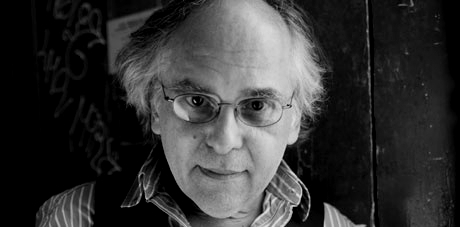
David Mamet is an American playwright,
screenwriter, and director. He was born in Chicago, Illinois, on November 30,
1947, in a Jewish family of a Polish descent. Mamet’s grandparents flee from Europe
to pursue the American Dream at the very beginning of the 20th century. Mamet
was raised in a typical American middle class family. Like many other
immigrants, his parents built their status on denial of their Jewish past and
were very much focused on acculturation. Although it may not seem like it at
first glance, Jewishness, Jewish experience and identity are very important in
Mamet’s work both on screen and on the page.
Mamet came to writing via acting. As a child
actor he would appear, in instructional dramas on radio and television. When he
went to Goddard College in Plainfield, Vermont, in 1965, he studied theater
theory as well as acting. Moreover, during his year off from the university, in
1968, he studied drama at the Stanislavsky-influenced Neighborhood Playhouse
School in New York. Then, after graduating from Goddard, he worked as an acting
teacher and cofounded the St. Nicholas Theater Company (later re-formed in
Chicago as the St. Nicholas Players), which produced much of his early plays. Mamet
has also taught acting and theater theory at the Yale Drama School and New York
University. Though he never claimed to be a real actor or to have any capacity
for it, the performance itself has become a central trope of his work.
The first play to put Mamet on the map was Sexual
Perversity in Chicago (1974). First staged by the Organic Theater,
voted best Chicago Play of the season, it was later transferred to Off Off and
Off Broadway where it picked up an Obie Award. American Buffalo (1975) was
staged on Broadway, with Robert Duvall, two years after its Chicago
premiere. It is the first of what he has called his ‘gang tragedies,’ and
it is about a group of tricksters who are conspiring to steal a coin collection
from a wealthy man. For this play Mamet received the New York Drama Critics
Circle Award. Also, the play was adapted for a 1996 film which starred Dustin
Hoffman. However, his most popular play appeared almost ten years later. Glengarry Glen Ross (1984) deals primarily with the time in American history when succumbing to the rigid rules of brutal capitalism was being advanced as moral virtue. At first it did very little
business in the US but when it opened to much praise in London, in 1983, New
York producers picked it up and staged it at John Golden Theater. Then it was awarded the Pulitzer Prize and the New
York Drama Critics Circle Award and, as a consequence, run on Broadway for 378
performances. From that moment onwards, Mamet’s career opened up with revivals
of his earlier work and a string of successes in the theater and the cinema.
Also, he became more exposed to criticism. Mostly by feminists who accused him
of being misogynist, not really including women in his work. Apparently, he
took this criticism seriously since, in the 1990s, he did manage to include
more female protagonists in his work. Speed-the-Plow (1988) and Oleanna (1992) both explore female
experience to some extent. The latter successfully registering contemporary
debates over gender roles, political correctness and the idea of sexual
harassment. His latest work includes plays titled November (2007) and Race (2009).
Also, in 2011 Mamet published a controversial book titled The Secret Knowledge: On Dismantling of American Culture, in which
he explains his recent conversion to conservatism. In December 2012 his new
play The
Anarchist will have its world premiere.
All in all, Mamet wrote 36 plays, 29
screenplays and several books on theater theory and criticism which makes him
one of the most prolific dramatists in contemporary America. As Chistopher
Bigsby puts it, "he is best known for his distinctive linguistic facility, his
fascination with the brittle relationship between the sexes, the figure of the
confidence trickster, and his concern with the moral vacuity at the heart of
much experience.”
by Sylwia Chlebowska
selected sources: